|
|
|
The Octave of Christmas and the New Year A special eight-day liturgical season in the Catholic Church, treating each day like a "little Christmas" to prolong the Nativity's joy, with recurring Gloria, special Communicantes in Mass, and specific daily feasts like St. Stephen (Dec 26) and the Solemnity of Mary, Mother of God (Jan 1).Quick Links to Octave Days: December 25th, 2025 to January 1st, 2026 Day 1 • Day 2 • Day 3 • Day 4 • Day 5 • Day 6 • Day 7 • Day 8
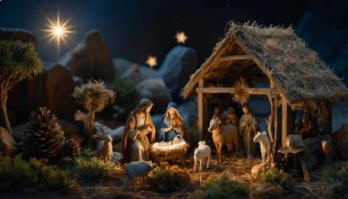
(1. Christmas Day) Thursday, December 25: The shepherds said, “Let us go, then, to Bethlehem to see this thing that has taken place.” They went and found Mary and Joseph, and the infant lying in the manger. When they saw this, they made known the message that had been told them about this child… The shepherds returned, glorifying and praising God (Lk 2:15-20).
Provision: So…what happens next? Imagine you are one of the shepherds. You return to your flock praising God, singing at the top of your lungs. You are amazed and incredulous: “Why would God announce this to lowly folks like us?!” A few of your fellow shepherds stayed behind to mind the sheep. You sit down on the cold ground, take a deep breath, and try to process the events of this night. The ones who stayed behind stare at you: “What the heck happened?” “Did you find this baby who is supposed to be our Messiah?” (We ask ourselves, “What the heck just happened? What are we celebrating and commemorating? Did the real thing get lost in all the hoopla of presents and eating and drinking and singing Christmas carols off-key at the top of our lungs!? Are we incredulous or doubtful? Did we—do we--see what was promised? [Don’t be hard on yourself. It’s a crazy time.])
You settle down a bit more. Your body is telling you to rest, but your mind is going a mile a minute, your heart is still beating fast. Everything is quiet except for the bleating of the sheep. You are lost in your thoughts, and know that in a few days, you will return home to your family. You think, “What am I going to tell them? Will they think I am nuts? Did they too, see and hear the angels? What am I to do now?” (Perhaps things have quieted down in your house, except for the beeping of new electronics. You reflect and ask this same question: “What am I to do now?”)
“When the song of the angels is stilled, When the star in the sky is gone, When the kings and princes are home, When the shepherds are back with their flock…The work of Christmas begins: To find the lost, To heal the broken, To feed the hungry, To release the prisoner, To rebuild the nations, To bring peace among brothers, To make music in the heart” Howard Thurman (Have a merry and blessed Christmas!)
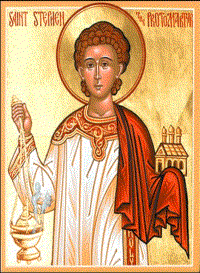
I assume from this passage that Stephen has been working miracles, “great wonders and signs among the people.” It doesn’t say that, though. We hear earlier in Acts of Peter curing the crippled beggar and the sick in Jerusalem (3:6-8; 5:15-16), and maybe Luke just didn’t take the time to document every miracle that happened. I don’t want to take anything away from Stephen, but what if the “great wonder” is that he was willing to show up despite the risks.
Provision: Show up. I’ve mentioned many times that I serve as a spiritual guide for members of the Ignatian Volunteer Corps in Baltimore, MD, USA. These fine folks, most in their 70s and 80s, show up at least eight hours a week to serve those less fortunate in our area. They companion, they teach, they read, they write letters, they comfort the elderly and dying, they do administrative work for our non-profit partners. They work “great wonders,” and sometimes, a miracle of healing in the lives of individuals and communities. They show up. You can too.
We’ve heard this line before, about joy being complete. Jesus says it: “I have told you this so that my joy might be in you and your joy might be complete” (Jn 15:11), “this” being remaining in his love and loving others as he has loved them.
Provision: Spread joy! We can’t be “Polly-annas,” ignoring the great suffering and injustice we witness in the world. Our willingness to show up, despite the risks and challenges, with mercy, compassion, and kindness, is a good way to spread joy, even if it’s just for a little while. Wherever you are, whatever you are doing, do it with joy and love!
I wish I could find the right words to get some people in my country to read this story with open eyes. I wish they could see in this passage the story of so many undocumented immigrants as they flee their homelands to save their families from forces looking to destroy them. I could provide links to all kinds of data sources, even ICE itself, that show a majority of those arrested in ICE raids have never committed a crime, much less a violent one. It doesn’t seem to matter. The answer is usually,” Well, being undocumented is a crime.” Really? “Being undocumented” seems, to some, to mean, “You’re illegal. You don’t matter. We don’t care.”
Provision: “Whatever you do, in word or in deed, do everything in the name of the Lord Jesus” (Col 3:12-17). “Blessed St. Joseph, you heeded the angel’s warning and fled in the night to protect your precious wife and child. We implore your care and protection for all who flee from persecution. Give them courage to stand up for their dignity and strengthen those who stand beside them as allies. Open the eyes and soften the hardened hearts of those who fail to see the Holy Family in these men, women, and children. We ask this, we do this in the name of the Lord Jesus. Amen.”
Simeon is content now and ready to die. He has seen the Christ. But he doesn’t get to experience the promised salvation during his lifetime. He just gets the satisfaction of knowing that sometime, somewhere in the future, all will be at peace, all will be saved. As Paul tells us in Hebrews 11, our ancestors in faith, “though approved because of their faith, did not receive what had been promised.” As we look around us, peace seems out of reach. And yet, like Simeon, we have seen the Christ. We too are patient, we too live in hope, trusting in God’s promise.
Provision: Rely on faith. I imagine most of us say we have faith, but does that faith run deep enough so that we could say to God, “Let your servant go in peace?” That’s a tough one, particularly when it comes to imagining the whole world at peace. We’d be happy just to see our families and communities getting along! What can you do to foster peace? Like Simeon, rely on faith and be open to the Spirit as she calls you to witness to the promise. (6. 6th Day in Octave) Tuesday, December 30: “Do not love the world or the things of the world… the world and its enticement are passing away. But whoever does the will of God remains forever” (1 Jn 2:12-17).
Let’s not misinterpret this passage. There is no more moving a prayer than to behold the majesty of God’s world, to be “enticed” by the beauty of creation, and then to be moved to protect God’s earth. It is God’s will that we love the earth and care for the gifts God has given us. When John refers to “the things of the world,” he means the enticements of our human condition that can overtake and replace the primacy of God in our lives. “Don’t love the world’s ways. Don’t love the world’s goods. Love of the world squeezes out love for the Father. Practically everything that goes on in the world—wanting your own way, wanting everything for yourself, wanting to appear important—has nothing to do with the Father. It just isolates you from him. The world and all its wanting, wanting, wanting is on the way out—but whoever does what God wants is set for eternity” (from The Message, by Eugene H. Peterson).
Jesus tells us, “Where your treasure is, there your heart is also.” The Sufi mystic, Rumi, says, “You are what you seek.” Treasure the earth and seek God’s will and your heart will remain with God forever.
Provision: Treasure Mother Earth. Unfortunately, a lot of laws that protect Mother Earth and her creatures are being rescinded, at least in the US, in favor of corporate profits and the economy. This is exactly what John is talking about today—how can you read it any other way? It’s important to remember this is God’s world. We must stop behaving like it is ours to do with it what we want. Do what you can to take care of Mother Earth, and advocate for laws to protect her.
Several of my friends are retiring soon (I’m
fortunate to know people who can retire!), and one of the activities they
are excited to undertake is looking into their genealogy. (We remember
listening to Jesus’ genealogy recently!) From our little ones asking, “where
did I come from?” to those wanting to get a sense of belonging and their
place in history, it’s interesting to find out about our roots. (There’s a
popular PBS show about this very thing.)
Provision: Commit to get to know Jesus in the New Year! You may say, “Oh, I know Jesus,” but really, are you more like Job: “My ears had heard of you” (42:5). Have your eyes, mind, and heart really seen him? Is Jesus an intimate friend? How does one get to know Jesus better? If you are a regular pray-er, you might consider the Spiritual Exercises of St. Ignatius in everyday life (https://www.ignatianspirituality.com/ignatian-prayer/the-spiritual-exercises/; I suggest you pray these with a director to help guide you.) Or just start reading the stories in the New Testament with an eye for what Jesus says, and what he means, imagining you are there listening to him. Picture the setting, the other people around you, and even what Jesus may be thinking and feeling. Get to know Jesus better in this new year.
By the time you read this, I worry the news may be filled with new atrocities as bad as what we’ve seen worldwide over the past few weeks, not to mention the “everyday” terror that occurs within families and in cities and countries all over the world. I don’t know if you are a New Year’s resolution person, but perhaps amid the personal commitments to lose weight, exercise more, spend less money, etc., etc., we all make a commitment to pray for peace.
© 2025, Elaine H. Ireland • Contact ehireland@gmail.com
|
|



.jpg)